Skip to main content
Remove advertising and get
10 GB!
of disk space for only
$9.95 USD per month
or
$109.95 USD per year
(plus local taxes).
Side panel
Home
More
Log in
Home
emilyrasoaenterprise.gnomio.com
EMMILY ONLINE COURSE
You
can
learn
agriculture
through
online
courses,
accredited
programs,
and
specialized
certifications
that
cover
crop
management,
sustainable
farming,
agribusiness,
and
precision
agriculture.
Online
Courses
and
Certifications
Platforms
like
Coursera
offer
a
wide
range
of
agriculture
courses
that
teach
crop
management,
soil
health,
pest
control,
and
sustainable
farming
practices
.
Courses
often
include
precision
agriculture
techniques,
GIS
mapping,
drone
monitoring,
and
data
analytics
for
yield
optimization
.
Popular
options
include
the
Land,
Agriculture,
and
Alternative
Investing
Specialization
and
Sustainable
Agricultural
Land
Management
courses.
Many
courses
allow
free
access
to
initial
modules
or
a
7-day
trial
for
full
content
and
certification.
Coursera
The
FAO
elearning
Academy
provides
free,
multilingual,
certified
courses
aimed
at
improving
global
food
security
and
sustainable
agriculture.
Their
programs
are
designed
for
researchers,
professionals,
and
students,
covering
topics
aligned
with
the
United
Nations
2030
Agenda
for
sustainable
agrifood
systems.
Food and Agriculture Organization
edX
also
offers
online
agriculture
courses
focusing
on
sustainability,
agribusiness,
and
technology
in
farming
,
helping
learners
understand
modern
challenges
like
climate
change,
resource
management,
and
food
system
dynamics.
edX
Accredited
Online
Programs
For
a
more
structured
education,
Nelson
Academy
of
Agricultural
Sciences
Online
provides
a
fully
accredited,
project-based
curriculum
designed
to
prepare
students
for
careers
in
agriculture.
Courses
are
developed
by
experienced
agriculture
educators
and
include
hands-on
activities
and
career-focused
content.
allagonline.com
Online
degree
programs
are
available
through
universities
such
as
Arizona
State
University
and
University
of
Tennessee
-
Martin
,
offering
Bachelor
of
Science
in
Sustainable
Food
Systems
or
Agricultural
Business
.
These
programs
combine
coursework
in
food
policy,
crop
and
livestock
management,
sustainability,
and
agribusiness
,
often
with
internship
opportunities
and
flexible
online
study
options.
OnlineU
Learning
Approaches
Hands-on
experience
:
Internships,
volunteering
on
farms,
or
workshops
provide
practical
skills.
Self-study
:
Books,
research
papers,
and
industry
publications
deepen
knowledge.
Networking
:
Engaging
with
local
agricultural
communities
and
professional
networks
enhances
learning
and
career
opportunities.
Skip available courses
Available courses
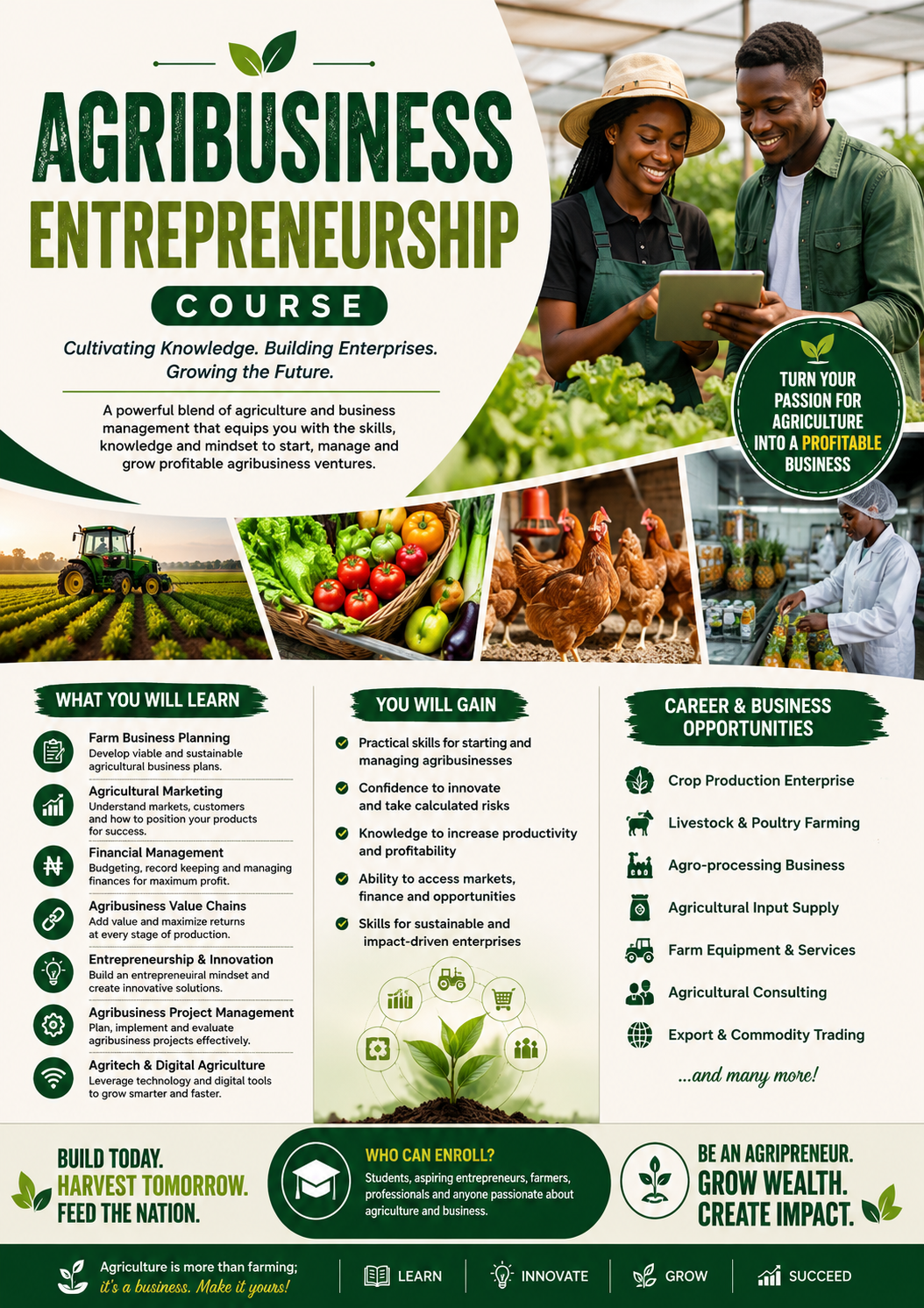
AGRIBUSINESS ENTREPRENEURSHIP
Teacher:
Emmily Rasoa
FARM MANAGEMENT AND FINANCE
Teacher:
Emmily Rasoa
CROP PRODUCTION
Teacher:
Emmily Rasoa